

 Автор
Автор Демоверсия ВПР 2026 по английскому языку 2 курс СПО файл образца демонстрационного варианта заданий с ответами и решением для подготовки к всероссийской проверочной работе для обучающихся по очной форме обучения по образовательным программам среднего профессионального образования на базе основного общего образования, завершивших в предыдущем учебном году освоение общеобразовательной дисциплины.
→ Скачать тренировочные варианты
Демоверсия ВПР 2026 по английскому языку для 2 курса СПО
VPR_SPO_AN_ZAV_DEMO_20261. Прослушайте текст и определите, какие из приведённых утверждений A–E соответствуют содержанию текста (1 – True), какие не соответствуют (2 – False). Вы услышите текст дважды.
A. Jack is suffering from a headache.
B. Jack believes museums are important for education.
C. There are no portraits in the gallery.
D. Tracy and Jack want to go to a cafe.
E. Jack likes landscapes.
2. Установите соответствие между текстами A–E и темами 1–6. Используйте каждую тему только один раз. В задании одна тема лишняя.
1. A chance to study the nature in person
2. Ways to get to the place
3. A place to have a meal or celebrate
4. A highly protected area
5. Water biological resources
6. A chance to learn about extinct species
A. Belovezhskaya Pushcha is a national park located within Białowieża Forest which is at the border between Belarus and Poland. It is one of the last and largest remaining parts of the immense primeval forest that once stretched across the European Plain. On the Belarusian side, the forest is known as the Belavezhskaya Pushcha National Park with an area of 1,771 square kilometres. The forest is home to 800 European bison, Europe’s heaviest land animal. Since 1992 it has been a preserved part of the UNESCO World Heritage Site Białowieża Forest.
B. The Nature Museum of the National Park is one of the largest and best museums in the Republic of Belarus in terms of its design and collection richness, it attracts around 150,000 visitors a year. The museum has 3 large and 2 small themed halls with a total area of 1320 square metres, which are mainly represented by the collections of individual elements of trees from all parts of the world. It also displays photographs of natural, historical, and cultural sites of Belovezhskaya Pushcha. The museum recreates the ancient trees and species of animals that disappeared from the forest many years ago.
C. For those who like fishing, there are various lakes in the park where recreational fishing is permitted. The lakes are extremely diverse and are located in different parts of the park. The lakes are treasure troves of different types of fish. The most common species are pike, carp, and others. For lovers of water recreation rowing and motor boats are provided, and commercial hunting and various types of games can also be organized. The park provides fishing equipment to be delivered to remote fishing locations by boats at a reasonable fee. The use of personal watercraft is also allowed.
D. For those who like personal interaction with nature, the Park offers three different routes for hikers. They are Dokudovo, lake rote, and the northern pass. Dried up in the 1960s “Dokudovo” swamp is a favourite place for wild ungulates feeding. In the morning and evening hours, you can see grazing bison, deer, roe, and wild boars, watch birds, among which large predators attract attention. The lake route passes, mainly, through pine, spruce, and black alder forests, which alternate with open areas of the flood plain of the Pravaya Lesnaya River, swamps, small glades, and abandoned gardens.
E. The restaurant “Belovezhskaya Pushcha” is located in the central manor of the national park.
The restaurant has 6 halls that are decorated in different styles and it has a capacity of 250
people. The menu of the restaurant offers dishes of Belarusian and European cuisine, as well as
original specialties and game dishes. The cozy atmosphere and live music create a pleasant
atmosphere for relaxation. The restaurant also offers catering services for birthday parties,
weddings receptions banquets, corporate events, or any other social event.
3. Прочитайте текст и заполните пропуски A–E частями предложений, обозначенными цифрами 1–6. Одна из частей в списке 1–6 лишняя.
The oldest potato pieces found by archaeologists were in Ancón, central Peru. They date back to 2500 BC. There’s also evidence from stone tools A______ early as 3400 BC. But it’s hard to be sure B______ in the ground. Potatoes from about 2000 BC were also found in the Casma Valley of Peru. Even older potatoes, from 800-500 BC, were found at Chiripa near Lake Titicaca. Archaeological findings also show C______ as a food during the time of the Tiwanaku people in the Andes (from 1500 BC to 500 BC). Boiled and steamed potatoes became common instead of just soups. Scientists studied ancient human skeletons and found out D______ the Andean diet, along with quinoa (a grain) and animals like llamas. Later, during the Inca period, people ate more maize (corn), but potatoes were still very common. Besides actual potato remains, ancient Peruvian artists also made ceramic pots shaped like potatoes. These pots showed potatoes in three ways: as clear pictures of the vegetable, as humanlike figures, or as a mix of both. This shows E______ the people who lived in the Altiplano region. The Moche people were fascinated by the potato’s bumpy and unusual shape. They often showed potatoes in their art as strange animals or humans, creating a feeling they called “mundo hororroso” (a scary world). Their potato art often explored ideas about physical differences and strange visions.
1) that potatoes became more and more popular
2) that potatoes were a big part of
3) that potatoes might have been around as
4) that potatoes were also a main food for most
5) because potatoes don’t last long
6) that potatoes were very important to
4. Прочитайте текст и вставьте вместо каждого пропуска, обозначенного буквами A–F, подходящее слово, выбрав его из списка. Каждое из этих слов может быть использовано только один раз. Два слова в списке 1–8 лишние.
In early summer, Russia and several dozen other countries celebrate International Children’s Day, a holiday dedicated to every child on Earth. International Child Defense Day was first celebrated in Russia in 1949. The decision was A______ at a special meeting of the International Democratic Union of Women in Moscow. On 1 June 1950, «International Child Defense Day» was celebrated for the first time in 51 countries around the world. Its purpose is to B______ public attention to the need to protect the rights of children. On this day in Russia, people discuss the problems of orphans, disabled and poor children. Children are C______ gifts and special events are organized for them. Various competitions are organized in Moscow, the capital of Russia, in which D______ are distributed to children. Various exhibitions and informative programmes are also organized. Children’s Day in most countries is E______ in a joyful atmosphere. However, the meaning of the holiday is not only fun – for adults, it also serves as a reminder of the challenges faced by children around the world such as F______ of education, involvement in harmful work, illness, hunger.
1. prizes
2. lack
3. made
4. prices
5. draw
6. luck
7. held
8. given
5. Прочитайте приведённый ниже текст. Вставь вместо каждого пропуска, обозначенного буквами A–E, нужное однокоренное слово, выбрав его из трёх предложенных вариантов (1, 2 или 3). Humans have always loved and used flowers. Most people think flowers are A_____. Many also love their wonderful smells. People enjoy seeing flowers growing in gardens. There are B_____ kinds of flowers all over the world. Flowers are like changed leaves. They are only found on flowering plants, called angiosperms. These plants C_____ later in the history of life on Earth. Plants can’t move to find a mate, so many flowers have developed ways to attract animals. These animals then help carry pollen between plants. Flowers that are pollinated by insects are called entomophilous, which means «insect-loving». These flowers and their insect D_____ have often changed together over a long time, a process called co-evolution. To understand how a flower is built, scientists often E_____ take it apart. They can then draw a diagram or write a special formula to show its parts. This helps them figure out what family the plant belongs to, often using a book called a flora.
6. Прочитайте приведённый ниже текст. Преобразуйте, если необходимо, слова, напечатанные заглавными буквами в конце строк с пропусками, обозначенными номерами 1–6, так, чтобы они грамматически соответствовали содержанию текста. Заполните пропуски полученными словами разборчивым почерком.
7. Представьте, что Вы общаетесь с другом по переписке. Ответьте на его вопросы. Напишите одно-два предложения при ответе на каждый вопрос. Ответы в виде одного слова или словосочетания не принимаются.
Текст для аудирования
Сейчас Вы будете выполнять задание по аудированию. Вы услышите запись дважды. После первого и второго прослушиваний у Вас будет время для выполнения и проверки задания. Все паузы включены в аудиозапись. Остановка и повторное прослушивание аудиозаписи не предусмотрены. Прослушайте текст и определите, какие из приведённых утверждений A–E соответствуют содержанию текста (1 – True), какие не соответствуют (2 – False). Вы услышите текст дважды.
Now we are ready to start. Tracy: Jack, you really look unhappy. I thought you’d be thrilled to be here. What’s wrong? You can tell me! Jack: Never mind, Tracy. It’s just a slight headache, that’s all. I’ll be fine. Tracy: It seems to me you never feel well when museums are on the schedule. Aren’t you enjoying the exhibition? Just take it easy, relax! After all, it’s your first time visiting the National Museum of American Art. Jack: I would if I could, believe me. It’s just annoying when you can’t have fun doing something. Tracy: Fun? You’re kidding, right? Museums are educational establishments for advancing our knowledge. You’re not expected to have fun like at a dog show or a flower exhibition. Jack: Oh, come on, this is boring! How much longer are we going to stay here? Tracy: Hang in there. I promise, it’ll get interesting. Look at that lovely portrait, for instance. Jack: Okay, it’s not bad. It looks like it must be from the 19th century.
So, I guess you like realism? Tracy: Actually, I don’t. But I enjoy looking at the hairstyles and dress designs from the past and they’re best shown in realist paintings. I’m really into fashion, as you know. Jack: Well, I prefer pictures that are true to life, where every leaf and every flower is depicted exactly as it really is. Tracy: Like in still life paintings? Jack: Well, yes. If I have to look at art, I’d rather see that kind of picture. Tracy: Then look over there, there’s a good one. Flowers in a vase, watermelons, grapes, cherries. Yum! It makes my mouth water. Jack: Now that you mention food, I could do with a snack right now. I haven’t had anything to eat since morning and I’m starving. Tracy: I’m sure there’s a café on the ground floor. Why don’t we get a bite to eat and then return to the gallery? Jack: Agreed. And if we have to go back, I’d love to see some landscapes. They’re inspiring! Tracy: Especially the romantic ones.
The dramatic contrasts in romantic landscapes are unbelievable. I’m glad you’re finally beginning to feel more enthusiastic about museums. Jack: I’m afraid you’ve missed the point. The sooner we begin, the sooner we finish. Let’s go eat something. You have 15 seconds to complete the task. (Pause 15 seconds.) Now you will hear the text again. (Repeat.) This is the end of the task. You now have 15 seconds to check your answers. (Pause 15 seconds.) This is the end of the Listening test.
Ответы
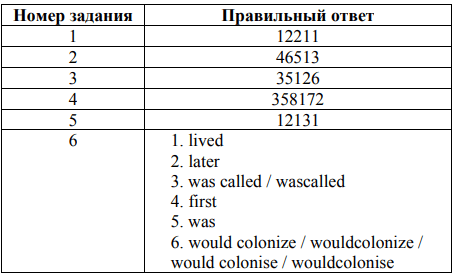
Критерии оценивания проверочной работы
Каждое из заданий 1–5 считается выполненным верно, если правильно указана последовательность цифр. В заданиях 1–5 участник получает 1 балл за каждое правильно установленное соответствие. В задании 6 участник получает 1 балл за каждое правильно преобразованное слово. Ответы на задание 6 считаются неверными, если грамматическая форма содержит орфографическую ошибку, но при этом допускается слитное написание составных (аналитических) грамматических форм. За успешное выполнение заданий 1–3 и 5 выставляется максимально 5 баллов; за успешное выполнение заданий 4 и 6 – максимально 6 баллов (по 1 баллу за каждый правильный ответ). Ответ на задание 7 оценивается в соответствии с критериями.
Смотрите для ВПР СПР по английскому языку
Демоверсия ВПР 2026 СПО по английскому языку 1 курс вариант, ответы, критерии